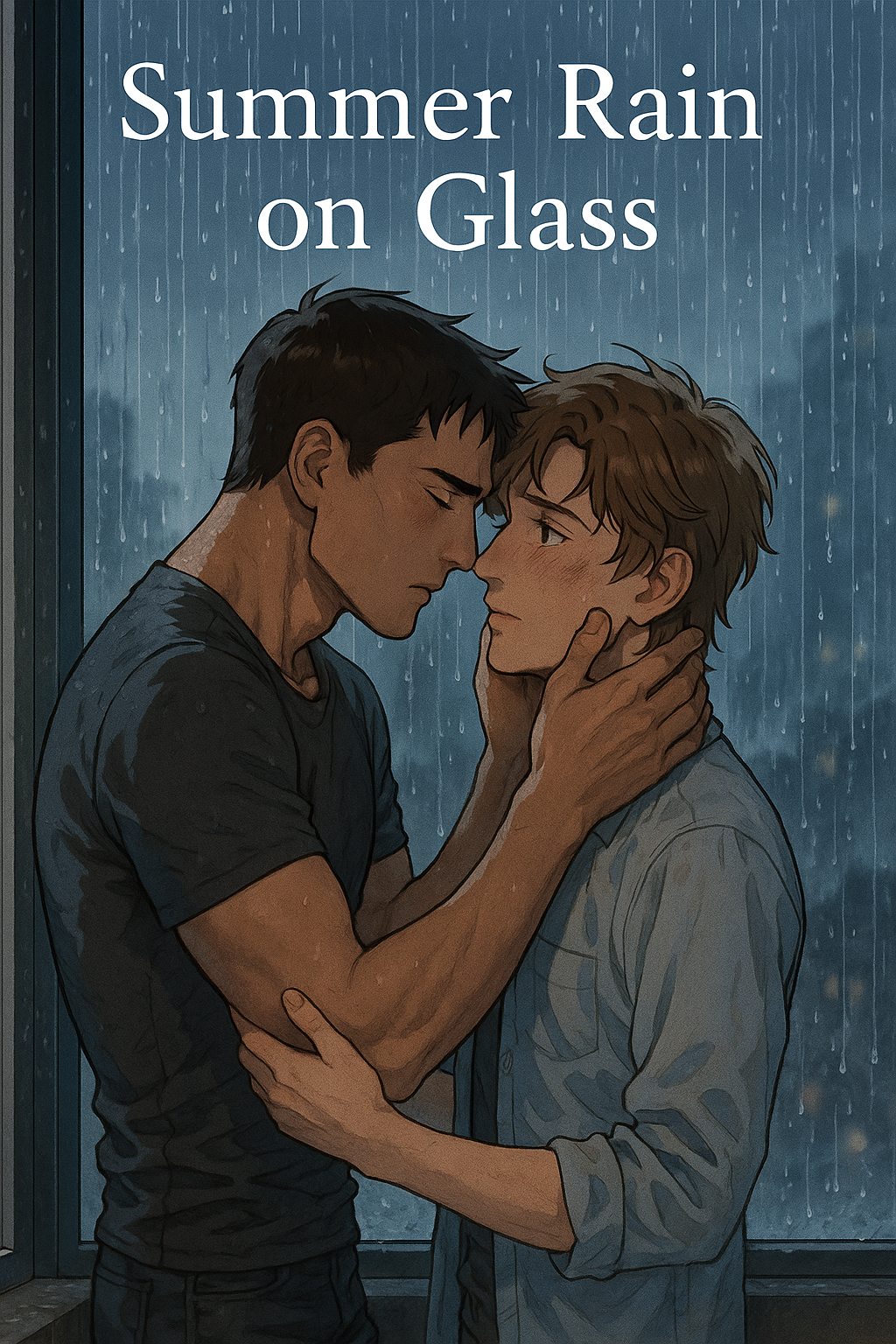
The rain had not let up since noon. It came down in clean silver cords against the old brick streets, rattling shop awnings and hushing the clamor of downtown into something softer. Inside Cadenza Café, the storm’s edge dulled into a metronome—steady, patient, the windowpanes ticking with each bead that slid and merged and fell. Light pooled warm over the wood tables; the espresso machine sighed like a cat settling in.
Alex stirred his tea though it had gone tepid long ago. He sat at his usual spot by the window, a seat he had not chosen so much as inherited because it made the outside feel farther than it was. He told himself he wasn’t waiting—nobody waits on a weather report—but every time the bell above the door rang, his heart rose as if tugged on an invisible string.
The string snapped taut when Daniel walked in.
He shrugged off the storm like it was merely an extra layer. Dark hair damp against his forehead. Jacket slicked with rain. That bright, slightly crooked smile that could undo the sleet in a day. His eyes scanned the room—the pastry case, the chalkboard menu, the small knots of students and couples—and landed on Alex with the soft inevitability of rain finding glass.
“You always sit by the window,” Daniel said, sliding into the chair across from him. He left his jacket folded over the back, drops gathering at the hem. “Waiting for me?”
Alex offered a practiced smirk that sat uncertainly on his face. “Maybe.”
The word lodged somewhere between a joke and a confession. They both noticed, and then they both pretended not to, and the pretending felt like a narrow bridge they had learned to cross without looking down.
They had met in this café in late spring. Daniel had borrowed a pen. Alex had offered the one he kept clipped to his notebook, the one with the squishy grip. They discovered the same fondness for old movies with overlong train station scenes, the same suspicion that summer was sometimes lonely if it was too bright. They learned each other in small increments: Daniel worked at an independent bookshop two blocks away, Alex was a library assistant finishing a one-year contract; Daniel drew in the margins of receipts, Alex wrote quietly in evenings he didn’t talk about. Somehow, without formally agreeing, they circled this table again and again—like a tracked clock hand, like the way rain cycles back in the forecast—until the sight of each other felt like returning to a secret kept in plain view.
“I wanted to tell you something,” Daniel said now, his voice dimmed to fit the small world of the table. He glanced at the window where the city refracted into smeared lights. “And I don’t want to make it dramatic. I just… every time it rains, I think of you. Because you’re the only one who makes it feel warm instead of lonely.”
Alex held still, the way one does when a bird lands on an outstretched palm. He searched Daniel’s face for the usual mischief, the tease that softened a statement’s edge. He found nerves instead.
“You don’t have to say anything,” Daniel added, as if trying to sweep his own words off the table before they left a mark. “I couldn’t keep it to myself anymore. That’s all.”
Alex’s hand moved before his sense could veto it. He reached across the table and laid his fingers over Daniel’s. The warmth surprised him—the heat of living skin, the small tremor there.
“I was hoping you’d say it first,” Alex said, and when he smiled this time, it felt like a door opening with a quiet click.
Outside, the rain tilted toward a hush. For a breath, the café disappeared: the clatter of cups, the barista’s low sing-song to an indecisive customer, the half-heard laughter from the corner. The glass was a mirror showing two silhouettes leaning in as if to hear one another better, and maybe they were.
They stayed until chairs began to perch on tables and the barista with the eyebrow ring announced closing in her sunny I-hate-to-do-this voice. Outside, the storm had softened to mist. The city’s evening neon bled into puddles, making a new kind of galaxy at their feet. They walked shoulder to shoulder, the space between them charged and almost unbearable and something neither of them wanted to bear separately anymore.
“You know,” Daniel said as they paused under a marquee, its bulbs ticking in a slow blink, “I used to think there was glass between us. Not the bad kind. The kind that lets you look and keep safe at the same time.”
Alex found Daniel’s reflection in the darkened shop window, found his own beside it. He could see where the raindrops tracked down and blurred their faces into something softer than truth. “Maybe the glass needs rain,” he said. “So we can see what’s really there when it fogs.”
Daniel laughed—the kind of laugh Alex stored away for days he forgot how to. He reached out and, tentative as a first note, pressed his forehead to Alex’s. It wasn’t a kiss. It was something older: a promise that came from the same place as a hand on a pulse, a check that the other was real.
“Come by the shop tomorrow,” Daniel said, close enough that Alex could see the small scar at the corner of his mouth he’d never noticed. “I’ve got something for you.”
“Another receipt drawing?” Alex asked, light.
“Maybe,” Daniel said. “Maybe not.”
They parted under the flicker of bulbs. The rain began again, but it wasn’t the same rain.
———————————————————————————————————————————————————————————————
The bookshop smelled like paper the way old trees might remember themselves if they could. Daniel waved from behind the counter, a ribbon tied to his wrist—a bright scrap of navy with tiny white anchors. “So,” he said when Alex reached him, “I did bring you something.” He reached under the counter and emerged with a small rectangle, wrapped in butcher paper and twine. The twine was tied in a bow. It was slightly ridiculous. It was perfectly Daniel.
“Open it later,” he said. “At the café. By the window.”
Alex arched a brow. “Conditions, Mr. Bookshop?”
“Atmosphere,” Daniel said smugly, then ruined the smugness by looking fond.
They did go to the café. They did sit by the window. Alex did untie the twine with more care than twine deserved. Inside was a slim notebook with a charcoal-gray cover and a single embossed line that caught the light like wet glass. Tucked into the first page was a receipt drawing: two figures under a shared umbrella. The umbrella was less an object than an idea—curved lines that implied shelter. One figure had a small curl of hair escaping from his hood. The other had a book held protectively in one hand, spine pressed to chest. Rain streaks became music staffs around them, the drops arranged like notes.
“Thought you could use a notebook you don’t mind ruining,” Daniel said. “With words.”
Alex looked up. It felt less like the gift was a notebook and more like it was permission.
He turned the page and found Daniel’s handwriting. It wasn’t neat. It was emphatic. A single line:
Write it down before the rain dries.
“I—” Alex began, and then realized he wasn’t sure what he wanted to say. Thank you was too small. This is everything was too much to ask words to hold. He slipped his fingers into the ribbon on Daniel’s wrist instead, then let go like he didn’t want to crease it.
“We should make a plan,” Daniel said, and the sudden utility broke the intensity into something livable. “You’re done at the library in two weeks, right?”
“Right.”
“Then we should do something that isn’t waiting out storms. There’s a summer film series at the old theater. Train station melodramas that last three hours. You’ll hate it, but we’ll hate it together.”
“I won’t hate it,” Alex said, but he smiled to show he knew this was a ritual—they enjoyed predicting each other’s inevitable reactions, then being together when those predictions were wrong.
They made a list. Not like a bucket list, because nobody was dying of anything that couldn’t be solved with time and stubborn care, but a summer list. Rooftop on an evening with a view. Cook something from scratch even if both of them forgot the salt at first. The train station movie. Watching rain from under a glass awning and naming all the strangers who passed.
“How do you name strangers?” Daniel asked, amused.
“You look for the first detail you love about them and then let that be their name. ‘Freckles who reads the last page first.’ ‘Umbrella held like an apology.’ Like that.”
“I love the way your brain names,” Daniel said, and the way he said it made Alex’s chest feel like a window the sun had just found.
———————————————————————————————————————————————————————————————
The first fracture arrived disguised as a courier package two days later. It was a thick envelope addressed in type to ALEXANDER DAWSON from a university press in Portland. Inside: a letter folded precisely in thirds, the kind of letter that made paper sound dignified. Dear Mr. Dawson, it began, in black serif calm. We are pleased to offer you a one-year extension as Visiting Archives Assistant, commencing September 1. In addition, we are excited to inform you that your proposal to oversee the “Letters in Transit” micro-exhibit has been accepted. We look forward to your continued contributions.
Alex was sitting at his small kitchen table which wobbled if you leaned too hard on the right corner. He read the letter twice. On the third pass, words began to blot as if the paper had picked up the day’s humidity. The exhibit was his idea: a series pairing handwritten letters with photographs of the places they were written, an attempt to show how text sometimes absorbs weather, light, the smell of a room. He had loved building it. He had loved staying late after the building emptied, holding words that had survived other storms. He had told himself the contract ending was a knife he could live with, the clean kind. Now someone offered to dull the edge with a year of the exact work he wanted.
Portland was nearly three thousand miles away.
He put the letter on the table as if it were a small sleeping animal he didn’t want to startle. Then he tidied the apartment; when he had no more surfaces to wipe, he went to the café. He needed the windows.
He got Daniel instead.
“Hey, you,” Daniel said, and his smile was enough to double the light. He had a paper bag in one hand. “The shop got in a shipment of these almond croissants that are basically illegal. I requisitioned two like an absolute tyrant.”
“Is requisition a bookshop word for stealing?” Alex asked, and hid his shaking hands in his jacket pockets.
“Only if you get caught. You okay?”
“Fine,” Alex said reflexively, and then he wasn’t. He took a breath. He could actually feel the letter sitting three blocks away like a magnet in a drawer. “I got extended. In Portland.”
Daniel’s expression didn’t collapse. It reorganized the way any plan does when someone pulls a pin and the whole blueprint has to flex. He set the paper bag down gently. “And your exhibit?”
“They said yes.”
“That’s huge,” Daniel said, and the delight in his voice was undimmed by the way his posture had gone a little careful. “You did that. You get to keep doing that.”
“I want to stay,” Alex said. He didn’t mean the city. He meant this: the window glass; the metronome rain; the boy with a ribbon tied to his wrist as if he were reminding himself he was tethered to something soft. “But I want that too.”
Daniel nodded slowly. He rubbed the inside of his left wrist where the ribbon sat. He had different ribbons on different days—navy anchors, maroon dots, a plain gray one that looked like it had been cut from a shirt hem. Alex had not asked why. He liked that some questions answered themselves over time. “What if wanting both isn’t the problem,” Daniel said. “What if the problem is deciding whether you can carry both at once.”
Alex stared at the croissants like they might tell him if this was one of those puzzles where you can ferry a fox and a chicken and some grain across a river but not all together. “Long distance is—”
“Hard,” Daniel supplied. “Do you want me to say it’s easy? I can, if you want the version where we lie to make the next minute simpler.”
Alex shook his head. “I want the version where we don’t back away before we even try.”
Daniel’s mouth twitched. “Good. Because I was going to be very offended if you asked me to set myself on fire as a preemptive safety measure.”
“You’re very dramatic for someone who wears ribbons.”
“Excuse you, these ribbons are for reality checks,” Daniel said, and when Alex lifted a brow, he tugged the navy strip free and turned his wrist up. There, in thin black ink, a small line of writing traced the underside: Remember to ask what you need. It wasn’t a tattoo—just pen. There were faint smudges from older notes near the pulse. Alex felt something in his chest turn slowly and slot into a new position. Daniel had been writing reminders on his skin because life took them away otherwise.
“What do you need?” Alex asked, and heard his voice find a steadiness as if it had been tuned.
Daniel looked out at the window. The rain was lifting; sun picked a corner of cloud and set it alight. He turned back. “If you go,” he said, “I need to know I’m not a layover.” He winced at his own metaphors. “I need to know that if we decide to do this, we both do it on purpose. With calls we schedule and keep even when we want to cancel and mope. With pictures of lunches and horrendous socks and the micro-drama of the bookstore customer who argues about Dickens being too modern. With visits that are easier some months and hard others. I need to know we don’t lie to each other because we think silence is lighter to carry.”
Alex swore his heart physically changed shape to fit the words. “I can do that,” he said. “I want to do that.”
“What do you need?” Daniel asked, as if the act of asking were part of the proof.
“I need you to tell me when my head is building disasters out of dust,” Alex said quietly. “I’m good at forecasting rain that never falls.”
Daniel’s hand slid over the table—slow, because slow made it more real. “Then we’ll check the sky together.”
———————————————————————————————————————————————————————————————
They built a scaffolding. It wasn’t grand. It was sturdy. Monday night calls. Pictures of window views traded like postcards—rain ribboning down Portland’s gray, sun puddling stubbornly on the bookstore’s glass. Alex mailed Daniel a first draft of a short piece about a letter that had traveled farther than its writer had. Daniel mailed back a receipt drawing of a letter with legs.
Their summer list altered to fit time. The rooftop became the roof of Daniel’s building the night before Alex left, a small illegal picnic of basil, tomatoes, too much bread, and the kind of cheese that required you to swear loyalty before it let you cut it. The train station melodrama became them watching the finale of a very old movie on Alex’s laptop while the storm spoke in the gutters. At the moment when the lovers in the film stood five feet apart and said something like, We can’t, because we must, Alex felt fierce protectiveness for two fictional strangers and for himself. Daniel threaded their fingers together. “We can, because we must,” he murmured. “Not forever. Just next.”
“Next,” Alex said, and thought of how the word could be a home.
The night was a riot of detail he wanted to write down and couldn’t: the constellation of city windows burning quietly, the wind skimming them with a hand that smelled like coming rain, the yeast-warmth of bread, the way Daniel said his name as if Alex were the first and last syllable in a poem that never ended. They kissed then, finally, a soft thing like the decision not to be afraid for one more minute. It was SFW in the most literal sense—safe for work, safe for living—because it left room for breath and laughing and the ridiculous tussle of who would stop first to make sure the other was okay. Alex had suspected kissing Daniel would feel like stepping into a familiar room with the lights turned on. He hadn’t expected the lights to be so kind.
They slept for a while on the couch with blankets heaped over them, the rain coming and going. It was both dramatic and calm, the way weather is. In the morning, Alex took the early train to the airport, a brown paper bag in his backpack that Daniel had pressed into his hands on the sidewalk. “Open it at cruising altitude,” he’d said solemnly, because he liked pretending to make his own superstitions official.
On the plane, Alex waited until the city was a quilt and then a fractal and then a memory. He untied the twine. Inside the bag: a deck of index cards held with a binder clip. The top card read Fortune Tellers for Adults and had a very dubious doodle of a paper fortune teller like kids made. Beneath it, in Daniel’s handwriting: thirty small prompts—one a day for the first month apart. Send me the name of the street you walk most often and three sentences about a window you love. Draw your hands. Yes, you can. I don’t need art, I need you. Record rain if it happens and send me the sound. The last card said simply: Ask for help when you need it, even if all you need is me to sit on the phone and breathe while you find the words. On the back, in tiny letters, I’m not going anywhere I can’t walk back from.
Alex pressed the deck to his sternum. He discovered you can cry quietly at thirty thousand feet if you pretend turbulence is doing it.
———————————————————————————————————————————————————————————————
Portland was rain and green and the smell of paper with a different history. The archive was a cool organism always humming, a place where the past didn’t sleep so much as keep watch. Alex loved it with a complicated love that included the ache of absence. He kept Daniel’s prompts on his nightstand. He kept the notebook with the embossed line in his bag; it fattened with notes, receipt doodles, and a pressed fern leaf he found on a path he was sure Daniel would tease him for discovering like he’d invented it.
On day ten, the sky broke open in a long low pour. He recorded the sound from his apartment window and sent it with a ten-second clip of himself grinning shyly and saying, “It sounds like home.”
Daniel sent a photo of the shop doorway beaded with droplets. Then, a second photo: his wrist with the ribbon lifted. On his skin, in fresh pen: This is still home too.
They learned the choreography of time zones and small failures and forgiveness. One night Alex missed a call because he fell asleep face down on a letter from 1931. He woke to three texts and an all caps voicemail that was mostly laughter: “ARE YOU CHEATING ON ME WITH A POSTMARK?” He sent back a picture of the offending letter with a caption: She’s older but she treats me right. Then, more seriously: I’m sorry. Can we try again now?
“Yes,” Daniel texted instantly, like he had been waiting at the door and didn’t want Alex to stand outside a second longer.
Some days it was wildly easy. The rhythm clicked. They swapped details: a child in the shop who announced to the entire travel section that he would be going to Paris “to punch the moon,” a researcher in the archive who wrote in tiny columns and hummed when she found a date that fit. Other days they were two radios searching each other through static. They said so. They let silence sit without making it a verdict.
When the first month ended, Alex mailed Daniel the deck of prompt cards back. He had written on the backs of some of them—small answers, raindrops taped on, a sketch of his left hand labeled The one that keeps reaching. Daniel mailed the deck again with new cards tucked in. On one was a drawing: the umbrella again, now with little motion lines—rain bouncing off, something like music under it. The figures had moved closer.
———————————————————————————————————————————————————————————————
Autumn thinned the rain into a finer script. The exhibit opened in November to a small crowd that included a man who cried so unexpectedly at a postcard written on a train that Alex offered him a chair and a glass of water and then pretended to need one himself. He called Daniel after the reception and walked outside so he could tell him under real sky. “We did it,” he said, not sure whether he meant the exhibit or the day or the fact that the world had contained both at once.
“You did it,” Daniel said. “I stood on the sidewalk and cheered so loudly they thought I was trying to start a second line.”
“Send a photo,” Alex demanded, and Daniel sent a picture of himself with a paper party horn and the solemnity of a judge.
There were visits. The first time Daniel flew west, he missed his connection and spent six hours in an airport where he saw three different versions of the same dog. He texted photos labeled Corporate Dog, Goth Dog, Dog Who Knows Taxes. When he finally arrived, windblown and exhilarated, they stood in the arrivals hall and did not do the movie run, because both were too busy laughing and also because Daniel insisted a dignified speed-walk was more realistic for people with carry-ons. They kissed like a letter found sound after a long silence and then kissed again as if to say: we are still in the same sentence.
They walked in parks where the ferns were prehistoric and wise. They stood on bridges. They pressed their palms to glass in the conservatory and let their reflections overlap with orchids. At night, they lay with their elbows touching and read aloud from a book of letters they had bought together and now absolutely had to annotate like two old professors with a shared red pen. “This one,” Daniel said, pointing, “says All my weather belongs to you. That’s too much.”
“It’s honest,” Alex said.
“It’s still too much.”
“Okay,” Alex conceded. “Then we’ll be people who tell the truth even if it’s too much and then adjust the curtains.”
“Adjust the curtains,” Daniel echoed, pleased. “Domesticity, thy name is metaphor.”
The second visit came in winter and was Alex’s trip east, timed to the bookstore’s holiday chaos. He learned that Daniel could charm an awful lot of people into buying paper they didn’t know they needed. He learned the squeak of the shop’s back door and the particular way the morning light traveled the floor. He learned all the ways the café had continued without him and all the ways it had kept his place open—not literally, just in the way the barista’s eyebrow ring flashed when she said, “Window’s free, as if the city knew.”
They watched snow that didn’t stick. They insisted upon gingerbread cookies that looked like suspicious men. They went to the old theater and sat through a film with three train station scenes and a fourth that existed only so the conductor could philosophize about chance. They held hands under the armrest. When the couple on screen finally managed to be in the same place at the same time, both of them looked at each other and grinned, as if they’d won something on behalf of strangers.
The year unspooled and rewound. They were not perfect. There were nights when one of them said “fine” and clearly meant “I am a small boat in a large rain.” There were days where the call felt like another appointment between meetings. But they kept asking: What do you need? They kept answering even when the answer was clumsy, or when the answer was I don’t know yet, can you sit in the hallway of my head while I look.
Daniel’s ribbons changed color. He still wore them, but sometimes he didn’t. Once, over video, he held up his bare wrist. “I forgot today,” he said, sheepish. “But I wrote it somewhere else.” He held up his palm. In pen: Drink water. Alex laughed too hard and drank water.
Spring slid in damp and green. The archive job ended one Friday at five with a quiet handshake and the kindly ache of leaving a place you loved well. That night, Alex made a decision in the small quiet of his apartment, which was more echo than furniture. He wrote it down—not because he would forget, but because he wanted the words to have a body.
He booked a one-way flight east for the following Friday. He told nobody but Daniel.
Except he didn’t, not yet. He kept it like a small lit thing cupped in his hands, and the week stretched delicious with the secret. He wanted to tell him in a place with rain on the glass.
———————————————————————————————————————————————————————————————
The plane descended into a storm that looked like someone was stitching the sky back together with bright thread. By the time he reached the city, the rain had steadied into a summer pour. Traffic hissed. Umbrellas were declarations. Alex shouldered his bag and walked the last block to the café with the kind of exuberant care you take when the thing you want is near and you don’t want to frighten it. The bell chimed. The barista glanced up, saw him, and executed a silent fist pump. “Window’s free,” she said, and then, conspiratorially, “He’s late. It’ll be good for him.”
Alex sat. The glass was already beaded. The street outside performed a scene he’d watched a hundred times: a cyclist who had not checked the forecast, a woman walking briskly in a coat that could have been any season, two teenagers choreographing a dance only they knew. The café had changed a little; it always did when you looked at it with eyes that had been away. The light felt the same. The chair still had the small wobble on the third leg. The window still framed the world like a photograph that was never quite still.
He smoothed the notebook’s cover. He had brought it on purpose. The embossed line caught the light. He turned to the first blank page and wrote a title: Summer Rain on Glass. Beneath it, one sentence: Sometimes the weather is not what you stand under but who you stand beside.
The bell chimed again. Daniel hurried in, hair already a mess from the sprint, jacket dark with rain. He stopped when he saw Alex. His face arranged itself into wonder and relief and something else Alex recognized as the discovery that a wish you’d been brave enough to say out loud could sometimes step into the room on its own feet.
“You’re early,” Daniel said, meaning for the call they’d scheduled, for the day Alex had said he’d be in town next.
“I’m home,” Alex said, and then, because the word tumbled too fast for explanation, he reached into his bag and found the folded paper that confirmed it. He laid the copy of his rental agreement on the table like a magic trick with a very unmagical font. He placed the key on top.
Daniel looked down. He made a small, indelicate sound that the café ignored for the privacy of love. He reached across the table with both hands and caught Alex’s like he could anchor him more firmly in place. “You’re home,” he repeated, reverent.
“If you’ll have me,” Alex said softly, because the sentence had lived in him since the plane banked into rain.
“I have you,” Daniel said, and it was not a promise so much as a report of the present.
They didn’t stand dramatically and kiss in the middle of the café. They did the thing they always did: leaned together until foreheads touched, breath syncing, everything else turning down. The storm drummed approval. Somewhere, perhaps out of frame, a child pointed at the window and asked where the rain went after it slid down; somewhere else, a person decided to text an old friend today; somewhere else, a couple in an airport bought a book because the cover felt like hope.
“What do you need?” Daniel asked after a while, an old question that never got old.
“A table by this window,” Alex said. “A pen that never runs out. Two almond croissants. One of your ridiculous ribbons so I remember this is not luck.”
Daniel fished in his pocket like a conjurer and pulled out a ribbon—charcoal with the thinnest sliver of silver down the center, like the exact shade of the embossed line on Alex’s notebook. He tied it around Alex’s wrist, fingers careful, knot firm but easy to undo.
“What do you need?” Alex asked.
“Rain,” Daniel said, smiling toward the window. “And us not waiting for it to tell us what we already decided.”
They ordered croissants. They revised their list. It had simple lines and complicated faith. Find a place with creaky floors. Hang one framed receipt drawing on a wall like a joke that remembers its own origins. Saturday mornings late, Tuesday nights early, the comma, the breath.
“Read me something,” Daniel said after a while, tapping the notebook.
Alex hesitated, then turned back from the title and wrote until the space between hand and heart felt transparent. He read the first page aloud. It wasn’t about them, not overtly; it was about light moving along a wall through a day, about the way rain makes privacy out of glass. Daniel listened with his whole face. At the last line, he squeezed Alex’s knee under the table in a small burst of pride that made Alex’s ribcage feel like a cathedral hearing its first song in a century.
“That one stays,” Daniel said.
They watched the rain together. Names presented themselves for the strangers outside—Umbrella Held Like an Apology; Freckles Who Reads the Last Page First; Red Scarf Who Drags the Weather Behind Them Like a Kite. They disagreed and laughed and chose together, and it was startling how often they picked the same names without worrying about being right.
When the storm finally gentled and the last thin bands of it unwound across the sky, the glass cleared but held a memory of the blur, as if the day were reluctant to give back the privacy it had made. The café lights glowed in the fresh clarity. The city looked both nearer and more possible. Alex closed the notebook, slid it back into his bag, and threaded his fingers through Daniel’s.
“If it rains tomorrow,” Daniel said as they stood, “we’re watching from the bookstore doorway.”
“If it doesn’t,” Alex said, “we’re walking without umbrellas.”
“Deal,” Daniel said, and then, as if it were the smallest and largest thing—because it was—he added, “Welcome home.”
They stepped out beneath the awning. The smell of wet pavement rose around them like a chord you know by heart. The last drops slid down the window and found each other. The city took a breath, and so did they, and they did not let go.